Best Grammar Book for Kids, 10 Smart Ways to Choose by Age
Best Grammar Book for Kids, 10 Smart Ways to Choose by Age Best grammar book for kids is a search many parents make when their






Best Grammar Book for Kids, 10 Smart Ways to Choose by Age Best grammar book for kids is a search many parents make when their
Grammar for Kids, Complete Parent’s Guide for Ages 4 to 10 Introduction Grammar for kids is one of the most important foundations for reading,
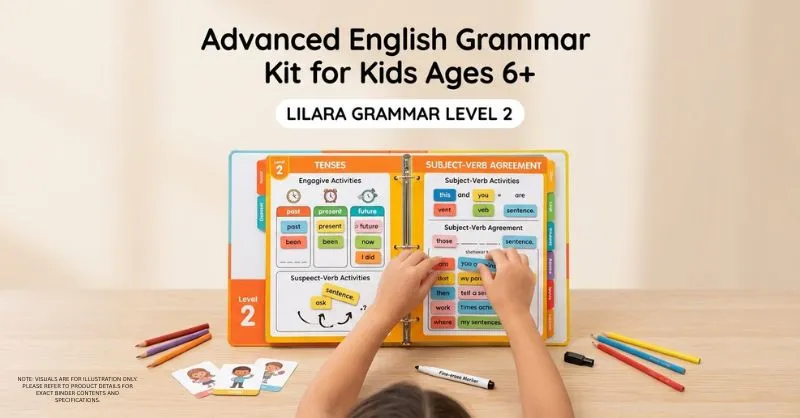
Advanced English Grammar for Kids, 10 Powerful Skills Every Child Needs Advanced English Grammar Kit for Kids Advanced English Grammar Kit for Kids helps
Reading time: 6 min · Age group: 5–8 years · Class: 1–2
Your child comes home with a grammar worksheet. They stare at it. You explain what a noun is. They nod. Twenty minutes later – same question.
This is not a learning problem. This is a teaching problem.
Most children in India are taught grammar as a list of definitions to memorise. But parts of speech for kids are not meant to be memorised – they are meant to make sense. And once they do, English writing, reading, and speaking all improve together.
This guide breaks down every part of speech in plain language any parent can use at home – no teaching degree required.
Parts of speech are the building blocks of every English sentence. Every word you speak or write belongs to a category – and that category tells you what job the word is doing.
There are 8–10 parts of speech that children need to learn, depending on the curriculum. For Indian school children in Class 1 and 2, the core ones are:
Nouns · Verbs · Adjectives · Pronouns · Prepositions · Adverbs · Conjunctions · Interjections · Articles · Question Words
Understanding these is not just about grammar marks. It directly improves reading comprehension, writing quality, and spoken fluency – skills that matter far beyond school exams.
For most Indian children, English is a second or third language. Grammar rules that feel obvious to native speakers – like when to use a vs an, or why we say she runs but they run – need to be explicitly taught and repeatedly practiced.
The problem is that classroom grammar teaching in India tends to be:
The result? Children can recite “a noun is a naming word” but cannot identify one in their own writing.
Activity-based grammar learning at home closes this gap faster than any tuition class.
A noun names a person, place, animal, or thing. If you can point to it or picture it, it has a noun.
Dog. School. Chennai. Mango. Riya. Happiness.
Home activity: Walk through one room. Name everything you see. Every word is a noun – and your child just learned twenty of them without a worksheet.
A verb tells us what someone does, is, or has. Every sentence needs one.
Run. Eat. Sleep. Is. Am. Are. Have.
The linking verbs – is, am, are – confuse most children because they do not look like “action” words. Yet they appear in nearly every sentence. Targeted practice on these three alone dramatically reduces the most common grammar errors in Indian school papers.
Adjectives describe nouns. They answer: Which one? What kind? How many?
The small, red bag. Three happy children. A cold morning.
Children use adjectives constantly in speech without realising it. Naming that skill helps them use it intentionally in writing.
Instead of repeating “Arjun went to the shop and Arjun bought milk,” we say “Arjun went to the shop and he bought milk.”
I, you, he, she, it, we, they, me, him, her, us, them.
Many Indian children mix up he and she in writing even when they never confuse them in speech. Written, structured practice is the fastest fix.
Articles are tiny words with big impact.
The a vs an rule trips up nearly every child learning English as a second language. It needs pattern practice, not just one explanation.
Prepositions show where, when, or how.
In, on, under, above, behind, beside, through, before, after.
Home activity: Hide a toy. Describe where it is using only prepositions. Children learn through movement far better than through reading.
Adverbs describe how, when, or where something happens.
She ran quickly. He came yesterday. They sat here.
Many children confuse adjectives and adverbs – writing “she sings beautiful” instead of “she sings beautifully.” This takes repeated sentence-level practice to correct, not just re-explaining the rule.
Conjunctions connect words, phrases, or sentences.
And, but, or, so, yet, because, although.
“I wanted to play but it was raining.” One conjunction transforms two flat sentences into a natural, flowing thought.
Wow! Ouch! Hurray! Oh no! Hmm.
These are the part of speech children love most – because they already use them every day. A quick lesson here builds enthusiasm for the rest.
What, Where, When, Who, Why, Which, How.
These are not just for asking questions. Children who understand question words can pull meaning from any text – a skill central to reading comprehension at every level.
| Age / Class | What to Focus On |
| Age 4–5 / Nursery–LKG | Nouns and action verbs through play |
| Age 5–6 / UKG–Class 1 | Adjectives, articles, pronouns |
| Age 6–8 / Class 1–2 | All parts of speech with structured practice |
| Age 8–10 / Class 3–4 | Deeper application – tenses, sentence types, SVA |
The earlier children are exposed to grammar in a playful, low-pressure way, the more natural it becomes.
There is a reason grammar learned through structured, repeated, hands-on practice lasts – and grammar learned only for exams disappears within weeks.
At-home grammar learning works best when it is:
If you are looking for a structured grammar learning kit for kids that covers all of this for Class 1–2 in one place, Grammarling 1 by Lilara is designed exactly for this age and level – covering articles, nouns, verbs, adjectives, prepositions, pronouns, adverbs, conjunctions, interjections, and question words in an activity-based, reusable binder format.
📺 Watch it in action: little ara – YouTube 📸 See inside the kit: Lilara India on Instagram & Lilara
Q: What are the parts of speech for kids in simple words? Parts of speech are the categories every English word belongs to – noun (names), verb (actions), adjective (descriptions), pronoun (replacements), preposition (positions), adverb (how/when/where), conjunction (joining words), interjection (emotions), and articles (a/an/the). Together they explain how sentences are built.
Q: What is the easiest part of speech to teach first? Nouns. Children already know hundreds of them and can physically point to examples. Start with nouns, then move to verbs, then adjectives – in that order.
Q: At what class do Indian kids learn parts of speech? Most Indian school curricula introduce parts of speech formally from Class 1, with articles, nouns, and verbs first, and more complex parts like adverbs and conjunctions from Class 2 onwards. Informal exposure from age 4–5 gives children a significant head start.
Q: How do I teach my child the difference between a noun and a pronoun? Write a sentence that repeats the same noun five times. Then rewrite it replacing some with pronouns. Ask which version sounds better. Children immediately understand – they just need to learn the name for what they are doing naturally.
Q: Why does my child confuse adjectives and adverbs? This is one of the most common grammar errors in Indian school writing and it is not a sign of weakness. The adjective-adverb distinction needs sentence-level practice repeatedly, not just a one-time explanation. Activity-based practice resolves it faster than re-teaching the rule.
Q: Is a grammar kit better than a grammar textbook for kids? For young learners between 5 and 8, activity-based easy grammar kits consistently outperform textbook-only approaches because they allow children to practice, self-correct, and revisit the same content in different formats – which is how long-term grammar knowledge is actually built.
Parts of speech for kids do not need to be complicated. Start with nouns and verbs this week. Add adjectives and articles next week. Give your child activities that let them use the grammar rather than just define it – and you will see the difference in their writing within a month.
Ready for a structured tool that covers it all? Get Grammarling 1 by Lilara →
Best Grammar Book for Kids, 10 Smart Ways to Choose by Age Best grammar book for kids is a search many parents
Grammar for Kids, Complete Parent’s Guide for Ages 4 to 10 Introduction Grammar for kids is one of the most important
Advanced English Grammar for Kids, 10 Powerful Skills Every Child Needs Advanced English Grammar Kit for Kids Advanced English Grammar Kit
Basic English Grammar for Kids – 12 Fun Activities Every Parent Should Try Introduction Basic English grammar for kids is one of